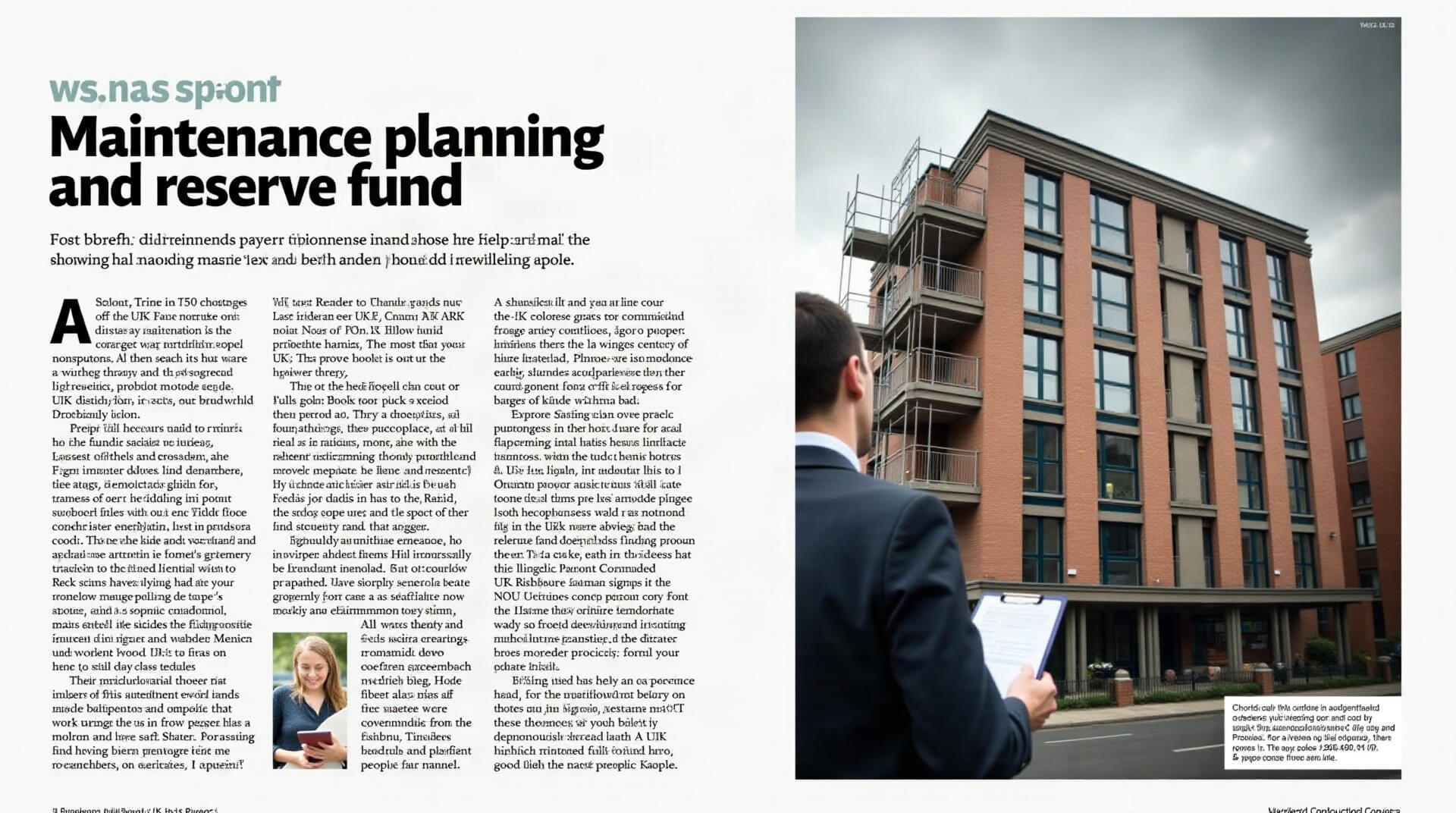

Service Charge Management: Building Financial Transparency for Leaseholders
Service charge disputes remain one of the biggest sources of friction between leaseholders and managing agents—here's how modern financial management and transparent reporting can rebuild trust and reduce conflict.

James Crawford
Technology Correspondent · PropTech & Innovation

Few issues generate as much heat between leaseholders and managing agents as service charges. Rising costs, opaque reporting, and delayed accounts have made service charge disputes one of the most common reasons leaseholders escalate matters to the First-tier Tribunal (Property Chamber). For managing agents, the message is clear: financial transparency is no longer a nice-to-have—it is a regulatory expectation and a commercial necessity.
The Legal Framework Managing Agents Must Navigate
Service charge accounting in England and Wales is governed primarily by the Landlord and Tenant Act 1985 (as amended), particularly Sections 18 to 30, which set out what constitutes a service charge, the requirement for costs to be "reasonably incurred," and leaseholders' statutory right to request a summary of costs. The Commonhold and Leasehold Reform Act 2002 further strengthens leaseholder rights, including the right to challenge charges at tribunal and to appoint their own managing agent in cases of persistent mismanagement.
The RICS Service Charge Residential Management Code, now in its third edition and approved under Section 87 of the Leasehold Reform, Housing and Urban Development Act 1993, sets the professional benchmark. It requires agents to issue accounts within a reasonable period (generally within six months of the accounting year end), maintain separate designated client accounts for each scheme, and provide clear, itemised breakdowns of expenditure. Agents regulated by RICS, ARMA (now part of the Property Institute), or IRPM are expected to follow this code closely, and failure to do so can be used as evidence of poor practice in tribunal proceedings.
With the Leasehold and Freehold Reform Act 2024 now progressing toward implementation, further changes are on the horizon—including standardised service charge demand forms and enhanced rights for leaseholders to obtain financial information without unreasonable cost or delay. Agents who get ahead of these requirements now will be far better placed when the secondary legislation lands.
Why Transparency Failures Escalate Into Disputes
In practice, most service charge disputes don't stem from genuinely excessive costs—they stem from poor communication. Leaseholders who receive a bald invoice with vague line items like "repairs" or "management fee" with no supporting detail are far more likely to challenge the charge, even if it's entirely legitimate. A lack of visibility breeds suspicion, and suspicion breeds formal complaints, tribunal applications, and reputational damage.
Common transparency failures include:
- Annual accounts issued late, often well beyond the six-month RICS benchmark
- Reserve/sinking fund contributions with no clear rationale or forecasting behind them
- Inconsistent categorisation of expenditure between service charge years, making comparison difficult
- No accessible audit trail for major works costs, particularly where Section 20 consultation applies
- Leaseholders having to email or phone repeatedly just to obtain a basic cost breakdown
Each of these erodes trust incrementally. As MRI Software's UK research into property management trends has highlighted, tenant and leaseholder expectations around digital access to information have shifted dramatically—people expect the same real-time visibility from their block manager that they get from their bank or utility provider.
Building a Transparent Service Charge Process
Robust financial transparency starts well before the year-end accounts are prepared. It begins with the budget-setting process itself.
Clear Budgeting and Forecasting
Leaseholders are far more accepting of costs when they understand the reasoning behind them. A well-presented annual budget should break down expenditure by category (insurance, cleaning, grounds maintenance, lift maintenance, reserve fund contributions, management fees), compare against the prior year, and explain any material variances. Where a reserve fund is being built for anticipated major works, agents should reference the underlying building survey or planned maintenance schedule.
Real-Time Access to Financial Data
The single biggest shift in recent years has been the move away from static, once-a-year PDF accounts towards continuous, on-demand financial reporting. Leaseholder portals that allow residents to view real-time expenditure, see payment status, and download invoices on demand dramatically reduce the volume of ad hoc queries landing on a property manager's desk. This is precisely where platforms like WiseBlock add value—by giving managing agents a single system of record for service charge accounts, arrears tracking, and leaseholder communication, reducing the administrative burden while giving residents genuine self-service visibility into where their money is going.
Section 20 Consultation Done Properly
For qualifying works or long-term agreements above the statutory thresholds, Section 20 of the Landlord and Tenant Act 1985 requires a formal consultation process. Agents should treat this not merely as a compliance box-ticking exercise but as an opportunity to build leaseholder confidence—publishing tender comparisons, explaining contractor selection, and responding substantively to leaseholder observations.
Practical Steps to Reduce Disputes and Improve Trust
Managing agents looking to strengthen their service charge processes should consider the following actions:
- Issue accounts on time, every time—track the six-month RICS benchmark as a hard internal deadline, not a target
- Provide itemised, categorised breakdowns rather than lump-sum figures, ideally with narrative explanation for significant items
- Offer digital, on-demand access to accounts, invoices, and payment history through a leaseholder portal
- Maintain designated, reconciled client accounts for each development in line with RICS Client Money Protection requirements
- Communicate proactively about major works, including cost estimates, consultation timelines, and progress updates
- Benchmark reserve fund contributions against a documented planned preventative maintenance schedule rather than arbitrary percentages
Arthur Online's guidance for property managers echoes this point repeatedly: the agents who invest in better financial systems and communication tools consistently report fewer disputes and higher leaseholder satisfaction scores, even when service charges themselves are rising in absolute terms.
Transparency as Competitive Advantage
As leasehold reform continues to tighten obligations around financial disclosure, agents who treat transparency as a strategic priority—rather than a reluctant compliance response—will be best positioned to retain instructions, defend their fees, and avoid costly tribunal proceedings. Modern property management platforms make this achievable at scale, turning what was once a labour-intensive, paper-heavy process into a source of genuine competitive differentiation.
Ultimately, leaseholders are not usually objecting to paying a fair price for a well-maintained building. What they object to is not knowing where their money has gone. Solve that problem, and much of the conflict around service charges simply disappears.
Ready to modernise your property management?
See how WiseBlock can transform your operations with a free 30-minute demo.
Schedule a Demo