

Maintenance Planning and Reserve Fund Strategies for UK Blocks
Reactive repairs and underfunded reserves are quietly draining leaseholder confidence and property values across the UK. Here's how managing agents can build robust maintenance plans and reserve fund strategies that stand up to scrutiny.

Emma Richardson
Finance Editor · Financial Management
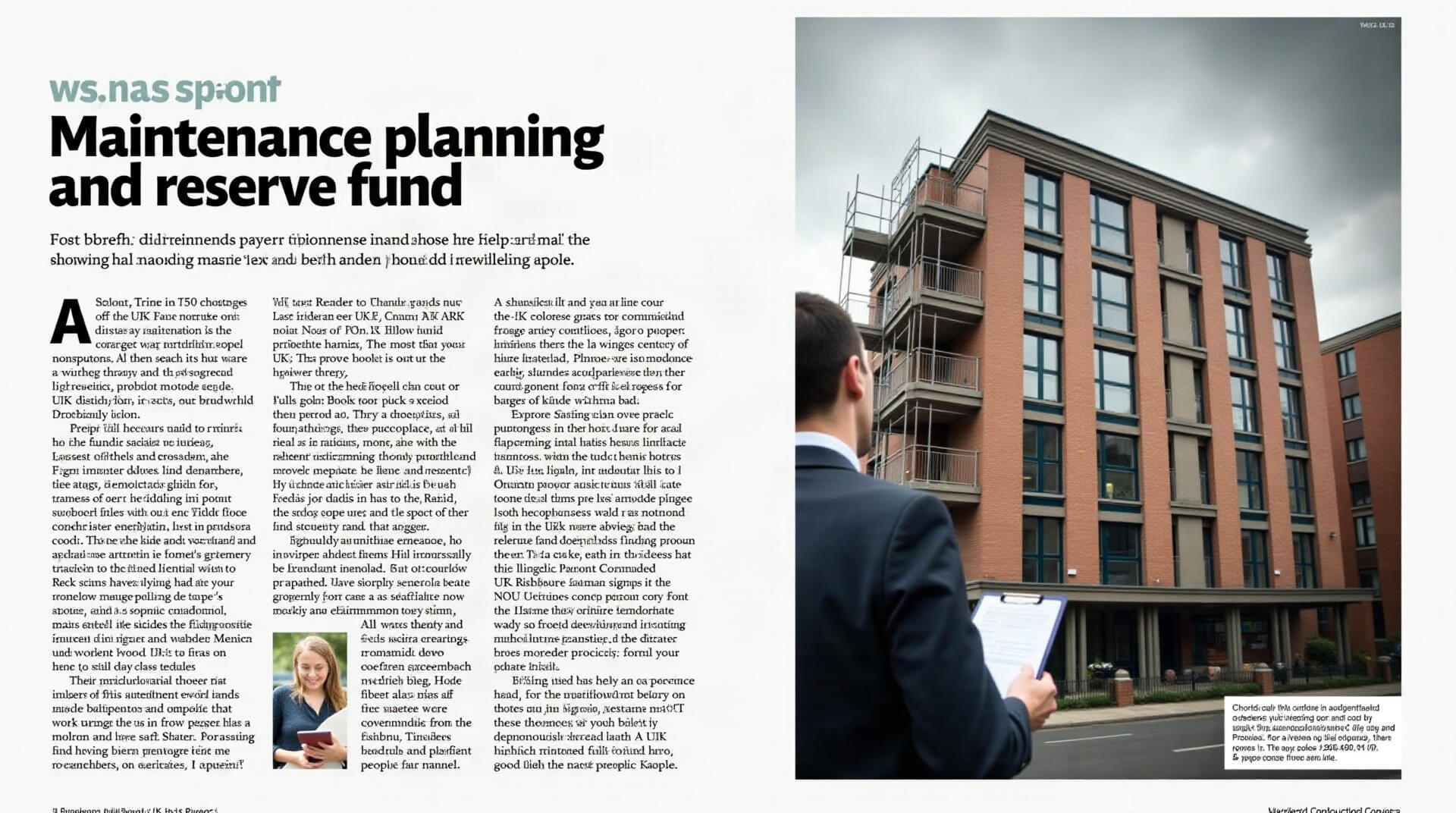
Few issues generate more leaseholder disputes, tribunal referrals and reputational damage for managing agents than poorly planned maintenance and inadequate reserve funds. Yet despite the well-documented consequences of getting this wrong, many blocks across the UK continue to operate on an ad hoc, reactive basis. A structured approach to maintenance planning, underpinned by a properly calculated reserve fund, is no longer optional best practice—it is fundamental to sound financial management and regulatory compliance.
Why Reactive Maintenance Is a False Economy
Reactive maintenance—fixing things only once they fail—might appear to keep service charges lower in the short term, but it almost always costs more over the life of a building. Emergency repairs typically carry premium contractor rates, disrupt residents, and often mask underlying issues that could have been addressed cheaply during routine inspection.
The RICS Service Charge Residential Management Code makes clear that managing agents have a professional obligation to plan ahead, not simply respond to problems as they arise. A block without a forward-looking maintenance schedule is a block storing up financial shocks for its leaseholders—shocks that frequently end up before the First-tier Tribunal when unexpected bills land.
Building a Robust Planned Preventative Maintenance Schedule
A Planned Preventative Maintenance (PPM) schedule is the backbone of any credible maintenance strategy. It should be built around a comprehensive building survey and typically includes:
- Major cyclical works, such as external redecoration (usually every 5-7 years) and roof replacement (20-25 year cycles)
- Mechanical and electrical asset lifecycles, including lifts, fire alarm systems, and communal boilers
- Statutory compliance inspections, such as fire risk assessments under the Regulatory Reform (Fire Safety) Order 2005 and, increasingly, obligations under the Building Safety Act 2022 for higher-risk buildings
- External envelope maintenance, including guttering, render, and window seals
A well-constructed PPM schedule should span at least ten years, ideally longer for major structural elements. This isn't simply a maintenance document—it is the financial engine that drives reserve fund calculations. Without it, any reserve figure is essentially guesswork.
Industry commentary from sources such as the Arthur Online blog consistently emphasises that agents who invest time in accurate asset registers and condition surveys are far better placed to defend service charge budgets when challenged by leaseholders or RTM companies.
Calculating Reserve Fund Contributions Properly
There is no single statutory formula for reserve fund contributions in England and Wales, but the RICS Code recommends that sinking or reserve funds be calculated with reference to the anticipated cost of major works, spread over the relevant cycle, and reviewed annually against actual costs and inflation.
A defensible methodology typically involves:
- Obtaining an up-to-date building survey and lifecycle cost projection from a qualified surveyor
- Apportioning costs according to the lease terms (equally, by floor area, or by rateable value)
- Building in a contingency allowance, typically 10-15%, for cost inflation in construction materials and labour
- Reviewing contributions at least every three years, or sooner following a major survey
Under-collection is a chronic problem. Many reserve funds were set decades ago and never rebased against current rebuilding and refurbishment costs. With construction material inflation running well ahead of general CPI in recent years, blocks that haven't reviewed contributions since before the pandemic are likely sitting on a significant funding gap.
Section 20 Consultation and Reserve Fund Interaction
Even a well-funded reserve doesn't remove the obligation to consult leaseholders under Section 20 of the Landlord and Tenant Act 1985 where qualifying works exceed £250 per leaseholder, or long-term agreements exceed £100 per leaseholder per year. However, agents who maintain a healthy, transparent reserve fund are in a far stronger position during consultation, because leaseholders can see that funds have genuinely been set aside rather than requested as a surprise one-off demand.
Transparency around reserve fund calculations, updated regularly and shared proactively with leaseholders, significantly reduces the likelihood of disputes escalating to tribunal.
Agents should also be alert to how reserve funds are held. Under Section 42 of the Landlord and Tenant Act 1987, service charge monies, including reserve contributions, must be held in trust, and ideally in designated client accounts, separate from the agent's own operating funds.
Technology's Role in Modern Reserve Fund Management
Spreadsheet-based reserve fund tracking is increasingly unfit for purpose, particularly for portfolios managing multiple blocks with differing lease structures and works cycles. Modern platforms bring real-time visibility to reserve fund balances, automate apportionment calculations, and flag when contributions are falling behind projected major works costs.
This is precisely the gap that WiseBlock is designed to close, giving managing agents a single, auditable view of reserve fund health across an entire portfolio, alongside the maintenance scheduling tools needed to keep PPM plans current. Rather than reconciling contributions manually every year-end, agents can monitor fund adequacy continuously and produce clear, leaseholder-facing reports that build trust rather than suspicion.
Commentary from MRI Software's UK blog similarly highlights how digitisation of service charge and reserve fund processes is becoming a competitive differentiator for agents seeking to win and retain management instructions, particularly as leaseholders become more financially literate and more willing to scrutinise annual accounts.
Practical Next Steps for Agents
Agents looking to strengthen their approach should:
- Commission or update a full building survey and lifecycle cost model within the next 12 months if one doesn't already exist
- Rebase reserve fund contributions against current construction costs, not historic figures
- Formalise a PPM schedule and share a summary version with leaseholders to build transparency
- Adopt software that provides real-time reserve fund visibility rather than relying on annual manual reconciliation
Maintenance planning and reserve fund strategy are not back-office administrative tasks—they are central to protecting leaseholder value, avoiding tribunal disputes, and demonstrating the professional competence that RICS and the wider industry now expect as standard.
Ready to modernise your property management?
See how WiseBlock can transform your operations with a free 30-minute demo.
Schedule a Demo