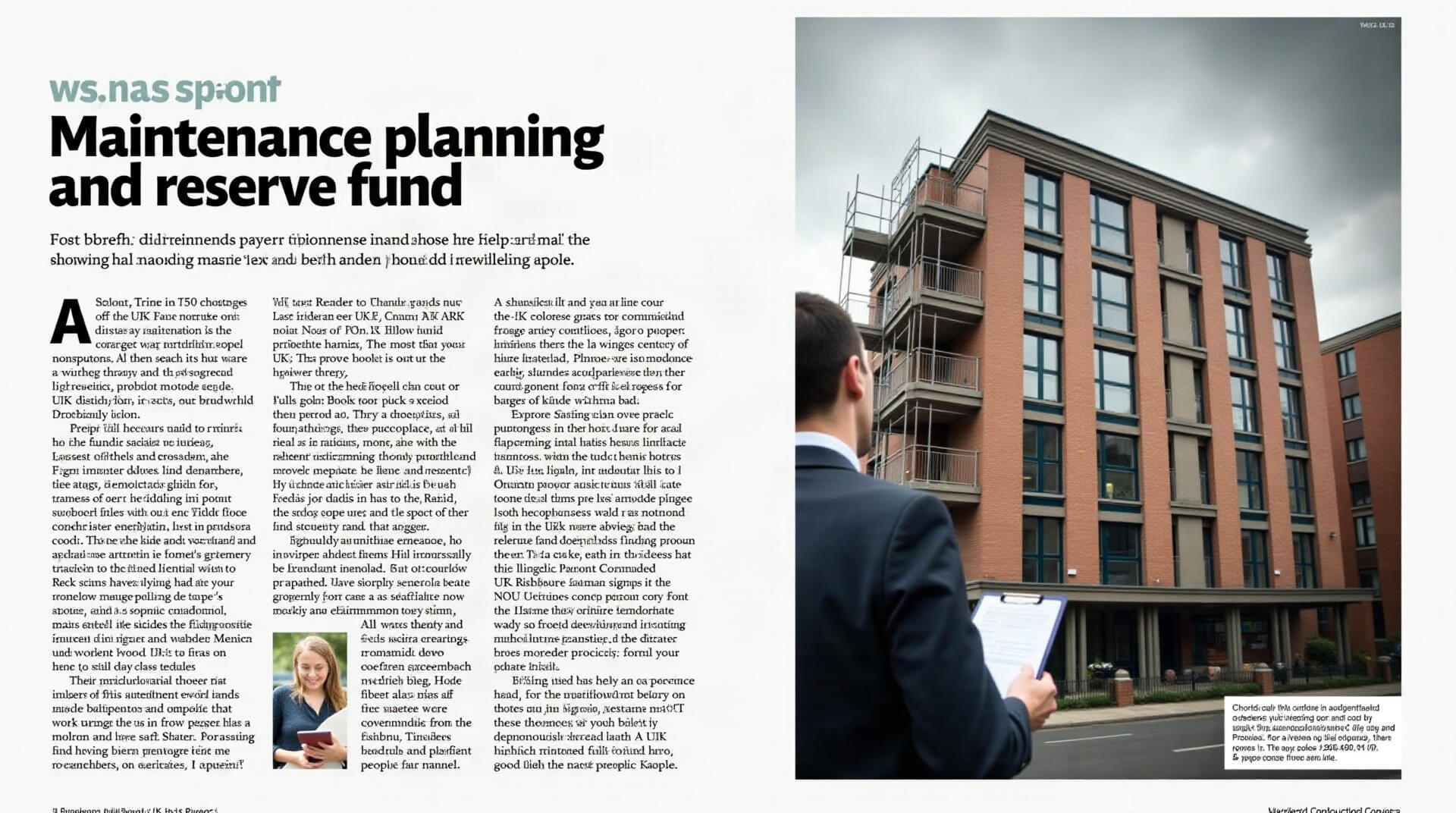

Insurance Requirements for Residential Blocks: A Managing Agent's Guide
Building insurance for residential blocks has become far more complex since the Grenfell Tower tragedy and the FCA's 2023 market study. Here's what managing agents and freeholders need to know to stay compliant and secure fair value for leaseholders.

Emma Richardson
Finance Editor · Financial Management

Buildings insurance for blocks of flats has moved from a routine renewal task to one of the most scrutinised areas of block management. Rising premiums, post-Grenfell fire safety concerns, and new regulatory obligations mean that managing agents can no longer treat insurance as a box-ticking exercise. Getting it wrong exposes freeholders, RMCs and leaseholders to significant financial and legal risk.
The Legal Foundation: What the Lease Requires
Most long leases place an express obligation on the landlord or Right to Manage (RTM) company to insure the building against fire, storm, flood and other specified perils, with the cost recovered through the service charge. However, the specific requirements vary considerably between leases, and agents must check:
- The minimum level of cover stipulated (often reinstatement value, not market value)
- Named perils versus "all risks" cover requirements
- Whether the lease requires cover for loss of rent, alternative accommodation, and public/employer's liability
- Any obligation to provide leaseholders with a copy of the policy or a summary of cover
Failure to insure adequately can constitute a breach of the lease, potentially giving leaseholders grounds for a claim against the landlord if a loss occurs and cover proves insufficient.
Reinstatement Valuations: The Most Common Failure Point
One of the most frequent insurance failures in residential blocks is under-insurance caused by outdated reinstatement cost assessments. Construction cost inflation, higher fire safety remediation costs and materials shortages have pushed rebuild costs up sharply in recent years. RICS guidance recommends that buildings undergo a professional reinstatement cost assessment (RCA) at least every three years, and ideally following any significant refurbishment or change of use.
Agents should never rely on the original purchase price, an outdated valuation, or a rough index-linked estimate. An accurate RCA should factor in:
- Demolition and site clearance costs
- Professional fees (architects, engineers, project management)
- VAT and statutory fees
- Fire safety and building control compliance costs for reinstatement under current regulations
The FCA's Multi-Occupancy Buildings Insurance Reforms
Following its 2023 market study into buildings insurance for multi-occupancy residential buildings, the Financial Conduct Authority introduced new rules that took effect for policies renewed or arranged from 31 December 2023. These reforms specifically target the practice of freeholders and managing agents receiving commissions that pushed premiums up without adding value for leaseholders.
Key requirements now include:
- A ban on commissions paid to freeholders, landlords and property managing agents in connection with buildings insurance placement — remuneration must instead reflect a fair fee for genuine work carried out
- Leaseholders must be treated as customers under the FCA's Insurance: Conduct of Business Sourcebook (ICOBS), with a duty to act in their best interests
- Mandatory transparency — leaseholders are entitled to a breakdown of the premium, including any fees, taxes and the basis on which the policy was selected
Managing agents should review contracts with insurance brokers to ensure remuneration structures comply, and should be prepared to provide leaseholders with clear, itemised documentation on request. Trade bodies such as the Association of Residential Managing Agents (ARMA) and the Institute of Residential Property Management (IRPM) have issued member guidance on implementing these changes, and non-compliance risks both FCA enforcement and leasehold disputes at the First-tier Tribunal.
Fire Safety and Post-Grenfell Underwriting
Since the Grenfell Tower fire in 2017, insurers have become far more risk-averse when underwriting blocks with combustible cladding, timber-framed construction, or unresolved EWS1 (External Wall System) assessments. Buildings awaiting remediation under the Building Safety Act 2022 have, in some cases, seen premiums increase by several hundred percent, or faced difficulty securing cover at all through the standard market.
For affected buildings, agents should:
- Engage early with specialist brokers experienced in high-risk residential blocks
- Consider the government-backed Fire Safety Reinsurance Facility, launched to stabilise the market for buildings with known fire safety defects
- Maintain a clear remediation timeline and share evidence of progress with insurers, as this can materially affect premium and terms
- Ensure the building's fire risk assessment (FRA) is current and any recommended actions are being addressed and documented
Under the Fire Safety (England) Regulations 2022 and the Building Safety Act 2022, responsible persons also have statutory duties around fire safety information that intersect directly with what insurers expect to see at renewal.
Practical Steps for Managing Agents
To meet both legal obligations and leaseholder expectations, agents should build a structured annual insurance process:
- Tender periodically, not just at renewal panic points — a competitive market review every two to three years, using an FCA-authorised broker, helps demonstrate value for money and satisfies the "best interests" duty
- Keep an up-to-date building risk register covering construction type, cladding status, fire safety measures and any claims history
- Disclose terms proactively — provide leaseholders with the policy schedule, sum insured, and a summary of cover as standard practice, not only on request
- Document the rationale for insurer and cover selection, particularly where price is not the sole deciding factor (e.g. claims service, financial strength, sector experience)
Digital platforms are increasingly central to managing this process well. WiseBlock allows managing agents to store insurance schedules, reinstatement valuations, renewal dates and fire safety documentation in one auditable record, with automated reminders ahead of renewal deadlines — reducing the risk of lapses in cover or missed disclosure obligations to leaseholders.
Looking Ahead
Insurance for residential blocks sits at the intersection of consumer protection, fire safety regulation and leasehold law, and all three areas continue to evolve. Agents who treat insurance placement as a strategic, well-documented annual process — rather than an administrative afterthought — will be far better placed to defend their decisions to leaseholders, tribunals and regulators alike.
This article is provided for general guidance and does not constitute legal or insurance advice. Managing agents should seek advice from a qualified insurance broker or solicitor for building-specific circumstances.
Ready to modernise your property management?
See how WiseBlock can transform your operations with a free 30-minute demo.
Schedule a Demo